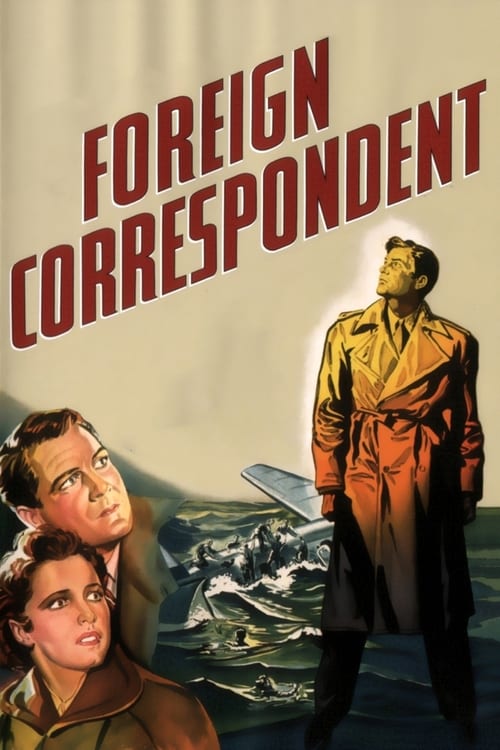
Foreign Correspondent (1940)
Genre
:
Thriller | Mystery | Action Rating
:
7 / 10
Release Date
:
16 August 1940 Resolution
:
1920x1080
Duration
:
2 : 0 minutes
Spoken Language
:
Deutsch, Français, English, Italiano, Latviešu Status
:
Released Overview
:
American crime reporter John Jones is reassigned to Europe as a foreign correspondent to cover the imminent war. When he walks into the middle of an assassination and stumbles on a spy ring, he seeks help from a beautiful politician’s daughter and an urbane English journalist to uncover the truth.
Cast Overview :

John Jones
by: Joel McCrea

Carol Fisher
by: Laraine Day

Stephen Fisher
by: Herbert Marshall

Scott ffolliott
by: George Sanders

Van Meer
by: Albert Bassermann

Stebbins
by: Robert Benchley

Rowley
by: Edmund Gwenn

Mr. Krug
by: Eduardo Ciannelli

Mr. Powers
by: Harry Davenport

Tramp
by: Martin Kosleck

Mrs. Sprague
by: Frances Carson

Stiles
by: Ian Wolfe

Assassin
by: Charles Wagenheim

Latvian
by: Eddie Conrad

Bradley
by: Charles Halton

Dorine
by: Barbara Pepper

'Mohican' Captain
by: Emory Parnell

Mr. Brood
by: Roy Gordon

Mrs. Benson
by: Gertrude Hoffmann

Captain
by: Marten Lamont

Steward
by: Barry Bernard

Asst. Commissioner
by: Holmes Herbert

McKenna
by: Leonard Mudie

English Announcer
by: John Burton

Van Meer's Impersonator (uncredited)
by: Samuel Adams
Donald's Wife (uncredited)
by: Meeka Aldrich
Man (uncredited)
by: Jack Alfred

Man (uncredited)
by: Bunny Beatty
Man (uncredited)
by: Frank Benson
Man (uncredited)
by: Billy Bester
Man (uncredited)
by: Henry Blair
Sophie (uncredited)
by: Becky Bohanon

Capt. Lawson (uncredited)
by: Louis Borel
Woman (uncredited)
by: Barbara Boudwin
Cousin Mary (uncredited)
by: Betty Bradley

Woman (uncredited)
by: Louise Brien
Man (uncredited)
by: Ronald Brown

Man (uncredited)
by: Horace B. Carpenter

Krug's Henchman at Windmill (uncredited)
by: Willy Castello
Man (uncredited)
by: George Cathrey

Committeeman (uncredited)
by: Wheaton Chambers
Fake Dutch Detective (uncredited)
by: Ken Christy

Mr. Naismith (uncredited)
by: E. E. Clive

Luncheon Waiter (uncredited)
by: Gino Corrado

Man (uncredited)
by: Maurice Costello

Minor Role (uncredited)
by: John Dawson

Uncle Buren (uncredited)
by: Harry Depp

Woman (uncredited)
by: Elspeth Dudgeon
Man (uncredited)
by: Carl Ekberg
Mrs. Stiles (uncredited)
by: Helena Phillips Evans

Parking Valet (uncredited)
by: Herbert Evans

Dutch Peasant (uncredited)
by: James Finlayson

Man (uncredited)
by: Robert Fischer

Man (uncredited)
by: George B. French
Man (uncredited)
by: Bill Gavier
Hotel Waiter (uncredited)
by: Jack George

Man (uncredited)
by: Douglas Gordon

Hotel Valet (uncredited)
by: Alexander Granach
Man (uncredited)
by: Richard Hammond
Luncheon Guest (uncredited)
by: Sam Harris

Man with Newspaper on Street (uncredited)
by: Alfred Hitchcock

New York Globe Teletype Operator (uncredited)
by: Otto Hoffman
Man (uncredited)
by: Billy Horn
Dr. Williamson (uncredited)
by: Paul Irving

Doctor (uncredited)
by: Colin Kenny

Toastmaster (uncredited)
by: Crauford Kent

Jones' Sister (uncredited)
by: Joan Leslie
Woman (uncredited)
by: Gwendolyn Logan

College Arms Hotel Cashier (uncredited)
by: Eily Malyon

Luncheon Guest (uncredited)
by: Eric Mayne
Man (uncredited)
by: Jackie McGee
Man (uncredited)
by: John Meredith
Man (uncredited)
by: Thomas Mizer
Luncheon Guest (uncredited)
by: Edmund Mortimer

Clark (Jones Family Member) (uncredited)
by: John T. Murray
Luncheon Guest (uncredited)
by: Henry Norton

Miss Benson (uncredited)
by: Jane Novak

New York Globe Copy Boy (uncredited)
by: George Offerman, Jr.
Boy (uncredited)
by: Lawrence Osman
Miss Pimm (uncredited)
by: Hilda Plowright
Airplane Passenger (uncredited)
by: Thomas Pogue

Donald (uncredited)
by: Jack Rice

Waiter (uncredited)
by: Ronald R. Rondell
Woman (uncredited)
by: Loulette Sablon

Sidewalk Crowd Extra (uncredited)
by: Harry Semels

Boy (uncredited)
by: Raymond Severn
Man (uncredited)
by: Frederick Sewell

Man (uncredited)
by: Ernie Stanton

Man (uncredited)
by: William Stelling

Eric (uncredited)
by: Donald Stuart

Man (uncredited)
by: Paul Sutton

Jones' Father (uncredited)
by: Ferris Taylor

Jones' Mother (uncredited)
by: Dorothy Vaughan
Man (uncredited)
by: Jack Voglin
Dutch Policeman (uncredited)
by: Hans von Morhart

Luncheon Guest (uncredited)
by: Larry Wheat
Man (uncredited)
by: Bert White
Dutch Motor Policeman (uncredited)
by: William Yetter Sr.

Auntie Maude (uncredited)
by: Mary Young
Luncheon Guest (uncredited)
by: Herschel Graham
Member Reviews :
If you enjoy this review, please check out my blog, Old Hat Cinema, at https://oldhatcinema.medium.com/ for more reviews and other cool content.
Alfred Hitchcock’s second American picture, Foreign Correspondent (1940), has quite literally everything you could ask for in a great movie. To categorize it, one might say it’s an espionage thriller. But really, that covers merely the basics of what the film is all about. It’s got suspense, adventure, romance, humor, heroics, and a cast that couldn’t be improved upon if you tried!
In contrast, Hitchcock’s first American picture was the well-done, if somewhat plodding, Gothic thriller Rebecca. While Rebecca is still an excellent film in its own right, boasting the talents of Laurence Olivier, Joan Fontaine, and others, it isn’t nearly as exciting or action-packed. Foreign Correspondent is the more important of Hitchcock’s films, made at the start of WWII, and a clear call for American entry into the war at that time. Rebecca may have won the Academy Award for Best Picture of 1940, but Foreign Correspondent was the more deserving film.
It’s 1939, and Europe is on the brink of war. An American reporter named Johnny Jones is sent to England as foreign correspondent for the New York paper he works for. He takes on the pseudonym Huntley Haverstock and is soon investigating the ostensible assassination of an important diplomat, uncovering a Nazi spy ring in the process.
Heading the cast are Joel McCrea and Laraine Day, two fine actors who are highly underrated today. The two of them maintain a good chemistry as the film progresses, and the supporting players are equally accomplished. George Sanders, that “dreadful man,” plays a wisecracking freelancer named Scott ffolliott, and gives a remarkable performance. Robert Benchley, as McCrea’s fellow foreign correspondent Stebbins, co-wrote the script, and is said to have written much of his own dialogue. There’s also Edmund Gwenn, cast against type as an affable Cockney hit man, and he makes the most of his short, but nonetheless important, role.
And, in his second film with Hitchcock, we have Herbert Marshall, in a truly great performance. I’ll have to leave it at that — because given half a chance, I could rattle on about the dear old chap for hours.
There are so many superbly crafted sequences in the movie, but I’ll mention just a few here. There’s the “umbrella scene,” where McCrea chases an assassin through a crowd of bystanders, getting lost amid the dozens of umbrellas. The windmill sequence, in which McCrea and his sidekicks find themselves alone in an open field, windmills softly turning with the breeze … or against the breeze, in the case of one such suspicious grinding mill, is marvelously shot. To add to the sense of urgency and danger, a single plane flies overhead. When McCrea sends Day and Sanders to fetch the police and enters the windmill himself, it’s one of the tensest parts of the film. Thirdly, when two men masquerading as police officers arrive at McCrea’s hotel room with malicious intent, he cleverly outwits them and escapes through the window, finding himself balanced precariously on a ledge far above the streets of London below … and dressed in his bathrobe. He proceeds to accidentally short circuit two of the letters in the hotel’s neon sign, reducing HOTEL EUROPE to HOT EUROPE, with a flourish that is purely Hitchcockian.
There’s also one brief but precious scene which for the most part probably goes unnoticed by audiences. During the car chase where McCrea meets Sanders, the assassin’s car rips around a corner, almost hitting a poor old man trying to cross the street. He steps back onto the curb just in time, and as he tries to cross again, our heroes go flying by, narrowly missing the man as well. As he tries to cross for a third time, a whole squad of policemen on motorcycles tear down the street, and the man, thwarted yet again, escapes back to the safety of the curb, turns around, and goes back inside his house. To the average viewer, it’s just one fleeting moment in the midst of an exciting, high-speed chase, but to be frank, the sequence had me in stitches; a glorious example of comic relief.
After a rollicking adventure across the continent of Europe, approaching two full delightful hours for the viewer, Foreign Correspondent reaches its climax in the form of a plane crash into the middle of the Atlantic Ocean … and one of the principal characters gives his life in a touching show of sacrifice.
So do yourself a favor, if, like me, you are a lover of great cinema, and enter this Hitchcockian world. Good triumphs over evil, witty banter abounds, romance blossoms, villains are heroes, and adventure awaits!
Alfred Hitchcock presides over quite a fast paced jigsaw-puzzle of a film with this gripping WII espionage thriller. Joel McCrae is the American reporter "John Jones" who is despatched by his editor to get decent news coverage of what's going on in war-threatened Europe. No sooner has he landed than he becomes embroiled in the affairs of the mysterious "Peace Party" leader "Van Meer" (Albert Bassermann) who may (or may not) have been gunned down and who may (or may not) have been party to a treaty that could change or even avert the course of war. Together with fellow journo George Sanders ("ffolliot") they become more deeply involved in this complex and intriguing mystery having to avoid just about everyone as they struggle to get to the truth. Herbert Marshall "Fisher" and his daughter "Carol" (Laraine Day) complete the quintet of principal characters ably as the whole story twists and turns in a structured and enthralling manner. There are red herrings, but they are not wasted - there is a thread to the story that ties them all together quite neatly as we begin to get to grips with who is to be relied upon - and who is not! The writing is not the most potent - too many contributors seem to lead, on occasion, to a battle of wordiness that I found just a little distracting; but Hitch is on form and there are plenty of tense scenarios to keep us all interested. Good stuff!