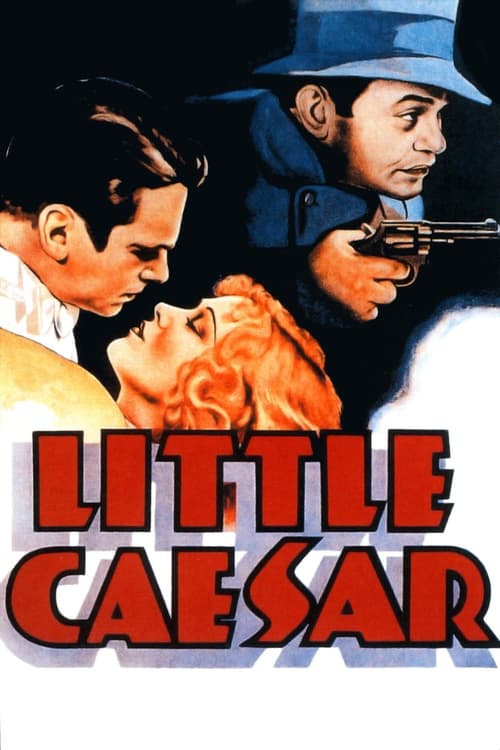
Little Caesar (1931)
Genre
:
Drama | Crime Rating
:
6.9 / 10
Release Date
:
25 January 1931 Resolution
:
1920x1080
Duration
:
1 : 19 minutes
Spoken Language
:
English Status
:
Released Overview
:
A small-time hood shoots his way to the top, but how long can he stay there?
Cast Overview :

Caesar Enrico 'Rico' Bandello aka 'Little Caesar'
by: Edward G. Robinson

Joe Massara
by: Douglas Fairbanks Jr.

Olga Stassoff
by: Glenda Farrell

Tony Passa
by: William Collier Jr.

Big Boy
by: Sidney Blackmer

Pete Montana
by: Ralph Ince

Sergeant Flaherty
by: Thomas E. Jackson

Sam Vettori
by: Stanley Fields

Little Arnie Lorch
by: Maurice Black

Otero
by: George E. Stone

De Voss
by: Armand Kaliz

Ritz Colonna
by: Nicholas Bela

Cashier (uncredited)
by: Ernie Adams
Undetermined Role (uncredited)
by: Elmer Ballard

Mrs. Passa (uncredited)
by: Ferike Boros

Detective (uncredited)
by: Kernan Cripps
Machine-Gunner (uncredited)
by: George Daly

New Year's Celebrant (uncredited)
by: Adolph Faylauer

Kid Bean (uncredited)
by: Ben Hendricks Jr.

Rico's 'Butler' (uncredited)
by: Al Hill

Ma Magdalena (uncredited)
by: Lucille La Verne
McClure Guest (uncredited)
by: Gladys Lloyd

Killer Peppi (uncredited)
by: Noel Madison

Detective on Phone (uncredited)
by: Tom McGuire

Hood (uncredited)
by: Louis Natheaux
Scabby (uncredited)
by: Henry Sedley
Nightclub Patron (uncredited)
by: Gay Sheridan

McClure Guest (uncredited)
by: Larry Steers

Alvin McClure - Crime Commissioner (uncredited)
by: Landers Stevens
Bodyguard (uncredited)
by: Mike Tellegen

Lorch Henchman (uncredited)
by: Bob Walker
Member Reviews :
You tell him the cops couldn't get me no other way, so they hired a couple of gunmen.
Rico Bandello quickly rises through the gangster ranks, earning himself the nick-name of Little Caesar. As he sets his sights on the top boss job held by Pete Montana, Rico knows the heat is closing in - fast.
Though not the first gangster picture to hit the big screen, Little Caesar is undeniably one of the genres landmark pictures. Adapted from W.R. Burnett's (High Sierra) Al Capone inspired novel, Little Caesar would go on to influence many of the genre highlights that followed, while in the process typecasting its star and icon, Edward G. Robinson. What is perhaps the first striking thing about viewing the film now is actually just how un-violent it is in context to what would follow it, and yet it never needs to be because this is not just about a violent uprising. With the advent of sound proving to be a winner with the fact that it's set outside of prison walls. The gangster genre by and large up to this point in 1931 consisted of mob characters behind bars, the sight of Rico about town amongst the noisy hustle and bustle surely would have depression jaded cinema goers, director Mervyn LeRoy exploits this by utilising opened the eyes and ears of the paying public.
I wasn't around back then so have no on the spot frame of reference, but the professional critics point to many allegories that reside within Little Caesar's structure. Talk of paranoias and conformities during economic collapse, which are for sure points of reference for those so inclined to analyse and dissect Caesar as a whole. Yet to me it's a gangster picture first and foremost, outlaying the rise and fall of a very dubious man with big ideals above his relatively small social standing. Rico has ruthless violence constantly itching to burst out, add in definite hints of sexual ambiguity and this makes him a troubling yet most intriguing character. That it works so well obviously is down to Edward G. Robinson's portrayal, big bulging eyes and snappy slang phrases (this themselves must have really hit a chord with the viewersback in the day), Robinson gives the performance that so many have imitated over the years, where he probably defined the archetype in the process.
It does look a little dated now, but of course that is only natural, but this is a powerful film that rises above merely being a hoodlum based piece. Producer Darryl Zanuck wanted something different for this burgeoning genre, and with the might of Warners revelling in the power of the talkie movie, they all crafted one hell of a picture that enthrals still today as much as it has influenced through the decades. Things most definitely changed with Little Caesar. 8/10
Edward G. Robinson is great in this early gangster talkie. He is "Rico", a clever and ambitious petty thief who decides it's time to move to the big city. Initially, he goes to work for "Sam Vettori" (Stanley Fields) but not long after, the local Crime Commissioner "McClure" is assassinated. Luckily, his buddy "Joe Massara" (Douglas Fairbanks Jr") is working at that self same club, and manages to warn "Rico" ahead of the subsequent police crackdown. It is now that he starts to smell an opportunity. First his boss, then the bigger boss "Pete Montana" (Ralph Ince) are toppled. Even his pal "Joe" and his gal "Olga" (Glenda Farrell) are not immune from his increasingly megalomanic tendencies. The thing I didn't especially like about this film is the ending - it is just a little too tame, but otherwise this is a solid effort from Mervyn LeRoy that really did bring out the best in Robinson with a quickly paced and enjoyable film.