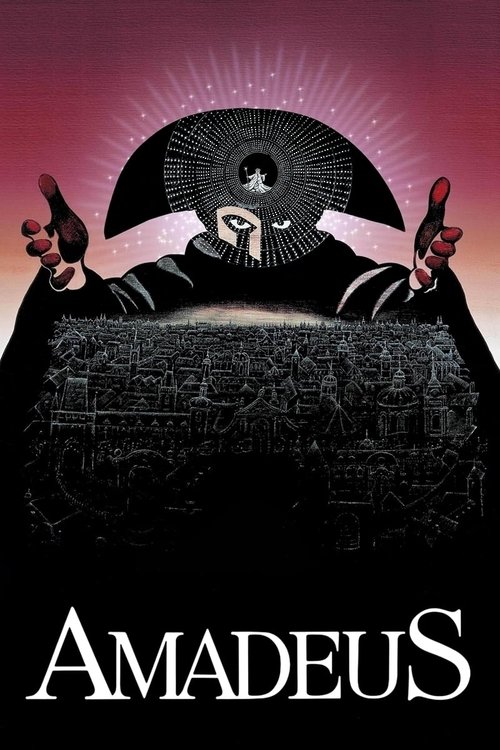
Amadeus (1984)
Genre
:
History | Music | Drama Rating
:
8.029 / 10
Release Date
:
19 September 1984 Resolution
:
1920x1080
Duration
:
2 : 40 minutes
Spoken Language
:
English, Deutsch, Italiano, Latin Status
:
Released Overview
:
Disciplined Italian composer Antonio Salieri becomes consumed by jealousy and resentment towards the hedonistic and remarkably talented young Viennese composer Wolfgang Amadeus Mozart.
Cast Overview :

Antonio Salieri
by: F. Murray Abraham

Wolfgang Amadeus Mozart
by: Tom Hulce

Constanze Mozart
by: Elizabeth Berridge

Emanuel Schikaneder
by: Simon Callow

Leopold Mozart
by: Roy Dotrice

Katerina Cavalieri
by: Christine Ebersole

Emperor Joseph II
by: Jeffrey Jones

Count Orsini-Rosenberg
by: Charles Kay

Parody Commendatore
by: Kenny Baker

Papagena
by: Lisbeth Bartlett

Frau Weber
by: Barbara Bryne
Young Salieri
by: Martin Cavani

Count Von Strack
by: Roderick Cook
Karl Mozart
by: Milan Demjanenko
Francesco Salieri
by: Peter DiGesu

Father Vogler
by: Richard Frank
Kappelmeister Bonno
by: Patrick Hines
Archbishop Colloredo
by: Nicholas Kepros

Salieri's Servant
by: Philip Lenkowsky
Priest
by: Herman Meckler
Baron Van Swieten
by: Jonathan Moore

Lorl
by: Cynthia Nixon

Hospital Attendant
by: Brian Pettifer

Salieri's Valet
by: Vincent Schiavelli

Count Arco
by: Douglas Seale
Young Mozart
by: Miroslav Sekera
Conductor
by: John Strauss

Wig Salesman
by: Karl-Heinz Teuber
Figaro in 'The Marriage of Figaro'
by: Miro Grisa

Figaro in 'The Marriage of Figaro' (singing voice)
by: Samuel Ramey
Countess in 'The Marriage of Figaro'
by: Helena Cihelníková

Countess in 'The Marriage of Figaro' (singing voice)
by: Felicity Lott
Count Almaviva in 'The Marriage of Figaro'
by: Karel Gult

Count Almaviva in 'The Marriage of Figaro' (singing voice)
by: Richard Stilwell
Susanna in 'The Marriage of Figaro'
by: Zuzana Kadlecová

Susanna in 'The Marriage of Figaro' (singing voice)
by: Isobel Buchanan
Cherubino in 'The Marriage of Figaro'
by: Magda Čelakovská

Cherubino in 'The Marriage of Figaro' (singing voice)
by: Anne Howells
Barbarina in 'The Marriage of Figaro'
by: Slavěna Drášilová
Barbarina in 'The Marriage of Figaro' (singing voice)
by: Deborah Rees
Marcellina in 'The Marriage of Figaro'
by: Eva Šenková
Marcellina in 'The Marriage of Figaro' (singing voice)
by: Patricia Payne
Basilio in 'The Marriage of Figaro'
by: Leoš Kratochvíl

Basilio in 'The Marriage of Figaro' (singing voice)
by: Alexander Oliver
Don Curzio in 'The Marriage of Figaro'
by: Gino Zeman

Don Curzio in 'The Marriage of Figaro' (singing voice)
by: Robin Leggate
Dr. Bartolo in 'The Marriage of Figaro'
by: Jaroslav Mikulín

Dr. Bartolo in 'The Marriage of Figaro' (singing voice)
by: John Tomlinson

Antonio in 'The Marriage of Figaro'
by: Ladislav Krečmer

Antonio in 'The Marriage of Figaro' (singing voice)
by: Willard White

Don Giovanni in 'Don Giovanni'
by: Karel Fiala
Don Giovanni in 'Don Giovanni' (singing voice)
by: Richard Stilwell
Commendatore in 'Don Giovanni'
by: Jan Blažek
Commendatore in 'Don Giovanni' (singing voice)
by: John Tomlinson
Leporello in 'Don Giovanni'
by: Zdeněk Jelen
Leporello in 'Don Giovanni' (singing voice)
by: Willard White
Cavalieri in 'Axur' (singing voice)
by: Suzanne Murphy
Constanza in 'Abduction from the Seraglio' (singing voice)
by: Suzanne Murphy
Queen of the Night in 'The Magic Flute' (singing voice)
by: June Anderson
Queen of the Night in 'The Magic Flute'
by: Milada Čechalová
Papageno in 'The Magic Flute' (singing voice)
by: Brian Kay
Papagena in 'The Magic Flute'
by: Lisbeth Bartlett
Papagena in 'The Magic Flute' (singing voice)
by: Gillian Fisher

Dancer
by: John Carrafa
Dancer
by: Sara Clifford
Dancer
by: Richard Colton
Dancer
by: Shelley Freydont
Dancer
by: Anne Glasner
Dancer
by: Barbara Hoom
Dancer
by: Mary Ann Kellogg

Dancer
by: Raymond Kurshals
Dancer
by: John Malashock
Dancer
by: Jennifer Rawe

Dancer
by: Tom Rawe
Dancer
by: William Whitener

Memeber of the Emperor's Family
by: Hana Brejchová

Sophie Weber
by: Miriam Chytilová

Leporello
by: Karel Effa

Soprano
by: Radka Fidlerová
Pasha
by: René Gabzdyl

Emperor's Spy
by: Karel Hábl

Dwarf
by: Aťka Janoušková
Princess Elisabeth
by: Marta Jarolímková
Singer
by: Gabriela Krčková
Dwarf
by: Vladimír Krouský

Dwarf
by: Jiří Krytinář

Salieri's Chef
by: Jan Kuželka
Blonda
by: Radka Kuchařová

Salzburg Man
by: Jiří Lír

Singer
by: Lenka Loubalová
Singer
by: Dagmar Mašková
Dwarf
by: Ladislav Mikeš

Actress
by: Jitka Molavcová
Dwarf
by: Jana Musilová
Musician
by: Vojtěch Nalezenec

Emperor's Spy
by: Pavel Nový
by: Jiří Opsatko

Emperor's Aide
by: Jan Pohan

Actress
by: Tereza Pokorná-Herzová
Man
by: Ivan Pokorný
Hofmarschall
by: Milan Riehs
Dwarf
by: Iva Šebková
Dwarf
by: Zdeněk Sklenář
Lady-in-waiting
by: Renata Vacková
Dwarf
by: Jiří Vančura

Josefine Weber
by: Dana Vávrová
Lady-in-waiting
by: Petra Vogelová
Dwarf
by: Josef Zeman
Wig Salesman (uncredited)
by: Viktor Maurer

Cardinal (uncredited)
by: Zdeněk Mahler
Pope Clement (uncredited)
by: Vladimír Svitáček

Mental Hospital Orderly (uncredited)
by: Karel Engel
Mental Hospital Orderly (uncredited)
by: Antonín Kramerius
Gravedigger (uncredited)
by: Zbyněk Bruthans
Pedrille (uncredited)
by: Lubomír Havlák
Member Reviews :
_**Lively costume biography about Mozart’s last nine years in Austria**_
Antonio Salieri (F. Murray Abraham) is a competent but mediocre composer in Vienna, Austria, in the late 1700s. He recognizes the God-given genius of the younger Wolfgang Amadeus Mozart (Tom Hulce) and struggles with bitter envy. The story is told in flashback as Salieri shares it with a cleric decades later at an asylum.
“Amadeus” (1984) is an entertaining costume drama that successfully takes you back to Vienna from 1783-1791. Mozart was basically the rock star of the era and some of his dynamic music even evokes certain modern rock styles. Giving the main characters personality helps bring the events alive and the flashback structure makes for compelling storytelling.
On the feminine front, Elizabeth Berridge plays Amadeus’ cute & feisty wife, Constanze, while Christine Ebersole is on hand as a ravishing opera singer, sorta reminiscent of Tina Root of Switchblade Symphony (albeit taller).
The original Broadway play concentrated on character motivation with music in the background while the movie focuses a little too much on it. Unless you’re an opera aficionado, the extensive scenes of Mozart's and Salieri's operas being performed become tiresome after a while and unnecessarily bloat the film, somewhat muting the story. When the Emperor yawns during a performance of “Figaro” I could relate because a lot of opera music sounds the same to me.
Nonetheless, this is an informative and amusing biography of Wolfgang’s last nine years; very well done.
The movie runs 2 hours, 40 minutes and was shot mostly in the Czech Republic.
GRADE: B+/A-
Rarely can I think of a more worthy multi-award winning performance than that from F. Murray Abraham in this masterfully crafted - if entirely speculative - retrospective on the life and times of Wolfgang Amadeus Mozart (portrayed here by the astonishingly effective Tom Hulce). Abraham portrays the duplicitous, envious and malevolent Antonio Salieri, the court composer to Emperor Joseph II of Austria (Jeffery Jones). He is talented, up to point, and settled in his politically influential and wealthy role, but growing up, he has always been aware of this other young boy who can play, perfectly, composing as he goes. Initially in awe of this man's predigious talent, it isn't long before the green eyed monster starts to rear it's ugly head, and jealousy soon starts to drive his every waking moment. Meantime, the young maestro is attracting more and more attention, acclaim and is soon rivalling Salieri for the attentions of the Emperor himself. At this stage, Salieri must act. How? Well fortunately he is ably assisted by Mozart's own self-destructive character. As a child, compared to a performing monkey, he always had issues with his father (Roy Dotrice) and even when married to Stanzi (Elizabeth Berridge) with his own child, we feel that he is always in search of adulation, appreciation and love whilst treading a very fine line between despair and a chronic fear of poverty and failure - one which leads him to an increasingly addictive existence. What is also striking here, is the extent to which Mozart's music has become pervasive in not just cinema history, but in our broader environment too. I found myself familiar - to varying degrees - with much of the superbly delivered soundtrack. It's all told via a rather apposite "confession" between Salieri and a priest who, as the story develops, struggles with his own faith and his belief that all sins can be forgiven. Perhaps some can't? The attention to detail here is fantastic: the sets, costumes and the location photography contribute hugely to the wonderfully rich look and feel of a film that just oozes style and confidence. Hulce's portrayal of the creative virtuoso as he descends into a maelstrom of misery is thoroughly convincing, and by the end - historical fact being adhered to, at least in this - I felt emotionally drained by the strength of these two tours de forces. A big screen with big sound is a must here, and I think you will find the three hours that this lasts will just fly by.