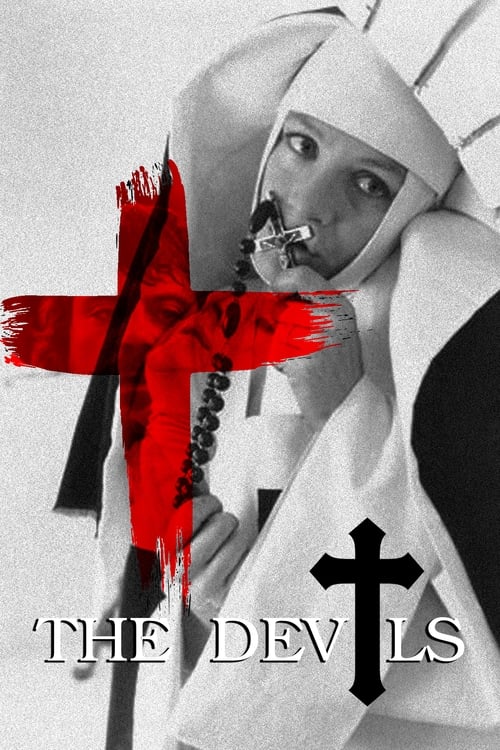
The Devils (1971)
Genre
:
Drama | History Rating
:
7.491 / 10
Release Date
:
16 July 1971 Resolution
:
1920x1080
Duration
:
1 : 54 minutes
Spoken Language
:
English, Latin Status
:
Released Overview
:
In 17th-century France, Father Urbain Grandier seeks to protect the city of Loudun from the corrupt establishment of Cardinal Richelieu. Hysteria occurs within the city when he is accused of witchcraft by the sexually repressed Sister Jeanne.
Cast Overview :

Sister Jeanne des Anges
by: Vanessa Redgrave

Father Urbain Grandier
by: Oliver Reed

Baron de Laubardemont
by: Dudley Sutton

Ibert
by: Max Adrian

Madeleine de Brou
by: Gemma Jones

Father-Canon Jean Mignon
by: Murray Melvin

Father Pierre Barre
by: Michael Gothard

Philippe Trincant
by: Georgina Hale

Adam
by: Brian Murphy

Cardinal Richelieu
by: Christopher Logue
King Louis XIII
by: Graham Armitage

Louis Trincant
by: John Woodvine

Rangier
by: Andrew Faulds

Legrand
by: Kenneth Colley

Sister Agnes (miscredited as Sister Judith)
by: Judith Paris

Sister Catherine
by: Catherine Willmer
Sister Iza
by: Izabella Telezynska

Nun (uncredited)
by: Niké Arrighi

Gossiping Woman (uncredited)
by: Pat Ashton
Citizen (uncredited)
by: Peter Avella

Nun (uncredited)
by: Imogen Claire
Vestal Virgin (uncredited)
by: Barbie Denham
Courtier (uncredited)
by: Hugh Elton
Soldier / Blackbird (uncredited)
by: Harry Fielder
Nun (uncredited)
by: Selina Gilbert
Vestal Virgin (uncredited)
by: Cheryl Grunwald
Soldier (uncredited)
by: Charles Price
Spectator (uncredited)
by: Charles Rayford
Spectator (uncredited)
by: Jack Sharp

Nun (uncredited)
by: Tina Simmons
Nun (uncredited)
by: Doremy Vernon

Pageboy (uncredited)
by: Twiggy
Spectator (uncredited)
by: Donald Campbell

Courtier (uncredited)
by: Justin de Villeneuve
Spectator (uncredited)
by: Fred Peck
Spectator / Clerk of Court (uncredited)
by: Tony Allen
Member Reviews :
With the very malleable Louis XIII (Graham Armitage) on the French throne, his minister Cardinal Richelieu (Christopher Logue) has decided to cement the regal authority by ensuring that all of the hitherto autonomous towns of the realm have their fortifications demolished. The one fly in his plague-ridden ointment is a town run by it's charismatic priest "Fr. Grandier" (Oliver Reed). It seems the only way his eminence can get his way is to discredit this, admittedly rather errant, man of the cloth. To that end, he despatches the "Baron De Laubardemont" (Dudley Sutton) to discredit this man. Unexpectedly, he finds that he might have an unlikely ally in the form of mother superior "Jeanne" (Vanessa Redgrave) whom, despite her protestations about sins of the flesh, has taken a bit of a shine to the enigmatic "Grandier". Seeing his opportunity, the baron sends for the zealously ruthless father "Barre" (Michael Gothard) and what ensues now could give anything attributed to the Spanish Inquisition a run for it's money. It's easy to see why this film would have caused consternation amongst the British Mary Whitehouse brigade as it unashamedly calls out the hypocrisies of the church by illustrating the sheer brutality of it's methods to seek and maintain control over the population and it rather chaotically sexualises nuns and priest in a way that was always bound to have the religious establishment in conniptions. It's problem fifty years on is that shock factor has largely been superceded by projects that have desensitised our readiness to be appalled by the excesses of the frocked community, but what does still stand out is a frankly disturbing effort from Redgrave - I reckon this is probably her most powerful performance on screen; a charismatic one from Reed and a maniacal one from a Gothard who really does get under your skin. The casting of sit-com legend Brian Murphy in a most untypical role (for him) also adds an extra dimension of the uncomfortable to the proceedings and during the entire couple of hours I never felt that happy endings were ever really on the cards. The production design of many of the interiors reminded me of those of a sterile and cold Victorian asylum (or public convenience) and this film just went to show that the spirit of the Borgias was alive and well in the seventeenth century. It isn't an easy film to watch, even now, but it does leave you wondering if this isn't a little closer to the ecclesiastical truthes of the period - like Hugo's "Hunchback of Notre Dame" or any version of the Jeanne D'Arc story, than many of the more "authorised" depictions of life when superstition and fear ruled so empathically.