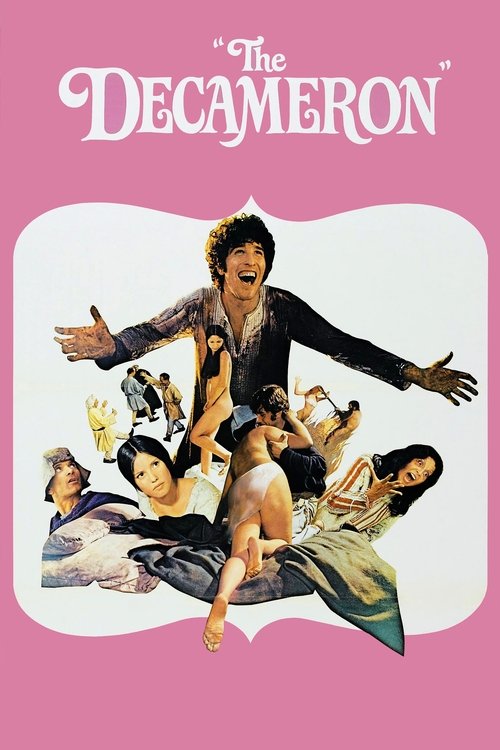
The Decameron (1971)
Genre
:
History | Drama | Comedy Rating
:
6.9 / 10
Release Date
:
25 August 1971 Resolution
:
1920x1080
Duration
:
1 : 51 minutes
Spoken Language
:
Deutsch, Italiano Status
:
Released Overview
:
A young Sicilian is swindled twice, but ends up rich; a man poses as a deaf-mute in a convent of curious nuns; a woman must hide her lover when her husband comes home early; a scoundrel fools a priest on his deathbed; three brothers take revenge on their sister's lover; a young girl sleeps on the roof to meet her boyfriend at night; a group of painters wait for inspiration; a crafty priest attempts to seduce his friend's wife; and two friends make a pact to find out what happens after death.
Cast Overview :

Ciappelletto
by: Franco Citti

Andreuccio of Perugia
by: Ninetto Davoli

Rustico (scenes deleted)
by: Jovan Jovanović

Peronella
by: Angela Luce
Masetto of Lamporecchio
by: Vincenzo Amato
Monk
by: Giuseppe Zigaina
Una Madonna
by: Maria Gabriella Maione
by: Vincenzo Cristo

Allievo di Giotto
by: Pier Paolo Pasolini

Lizio da Valbona
by: Giorgio Iovine
by: Salvatore Bilardo
Giannello
by: Vincenzo Ferrigno

Musciatto, Wealthy Merchant
by: Guido Alberti
Don Giovanni
by: Vittorio Vittori

Father Superior
by: Gianni Rizzo

Nun
by: Patrizia De Clara

Queen of Skulls
by: Monique van Vooren

Monk
by: Enzo Spitaleri
Monk
by: Luciano Telli

Caterina (uncredited)
by: Elisabetta Genovese
by: Luigi Seraponte
by: Antonio Diddio
Gemmata
by: Mirella Catanesi
by: Vincenzo De Luca
by: Erminio Nazzaro

by: Giovanni Filidoro
Don Gianni
by: Lino Crispo
by: Alfredo Sivoli

The Madonna (uncredited)
by: Silvana Mangano

Padre Superiore
by: Giacomo Rizzo
by: E. Jannotta Carrino
by: Annie Marguerite Latroye
by: Gerhard Exel
by: Wolfgang Hillinger

by: Giani Esposito
by: Franco Marletta

by: Vittorio Fanfoni
by: Adriana Donnorso
by: E. Maria de Juliis

Compagno di Giotto
by: Guido Mannari
by: Michele Di Matteo
by: Giovanni Scagliola
by: Giovanni Davoli
by: Detlef Uhle
Alibech (scenes deleted)
by: Patrizia Capparelli
(uncredited)
by: Lucio Amatelli
Lorenzo (uncredited)
by: Giuseppe Arrigio
(uncredited)
by: Giuliano Fratello
Riccardo (uncredited)
by: Francesco Gavazzi

Man Robbed by Ciappelletto (uncredited)
by: Carmelo Reale
Member Reviews :
If you were ever to be in any doubt as to Pier Paolo Pasolini's scepticism of all things religious, then you won't be after this entertainingly surreal interpretation of Giovanni Boccaccio almost heretical 14th century novels. There are nine episodes here that deal with just about everything you would find in a dictionary of sin - fraud, lust, theft, more lust, murder, covetousness and yep - even more lust. A couple of the segments stood out for me. There's a deaf mute who manages to convince a convent of nuns that he an unique solution to many of their problems - and boy, are they keen. Then there are some rather ruthless grave robbers who don't care who's tomb they plunder. A priest who uses his ingenuity to have his wicked way with a parishioner's wife - whilst her husband holds the lantern and maybe my favourite that sees a girl's parents craftily arrange a marriage for their daughter after she's spent an erotic night on the terrace with her beau! It oozes satire pretty much throughout illustrating quite openly the hypocrisy of the church and of it's "employees: and very much exposing the do as I say not as I do mentality that prevailed not just in Italy, but pretty much throughout Europe at the time. It's not just the religious who get a pasting here, the aristocracy don't come off a great deal better as they try to use their money to buy some redemption down the line - much to the joy of the painters who have no such compunction. It has something of the medieval farce to it, and that can be hit or miss, but for the most part the underlying commentary from the director is well enough disguised in frippery and humanity to not look like a reverse indoctrination. We can readily laugh at multiple aspects of the plot simultaneously. Nudity abounds here with just as much camera adoration of the male body as the female, but usually that just adds to the humour of the stories rather than overtly sexualising them. It's maybe a little long, but it's quirky and the episodic nature of the presentation ensures there's certainly no time to get bored.