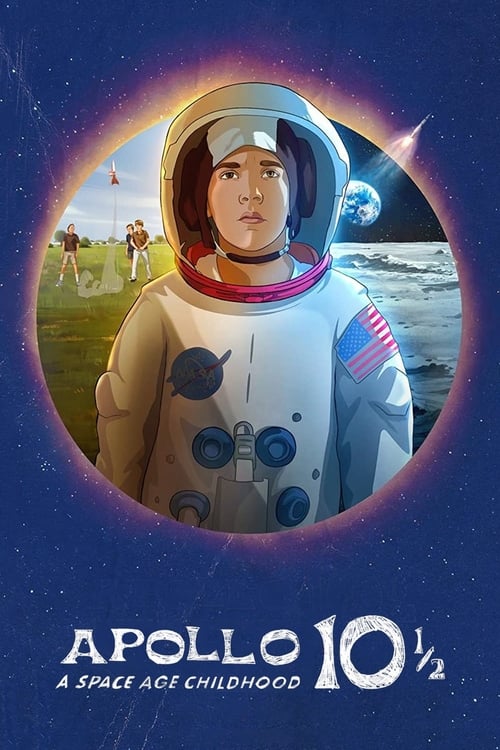
Apollo 10½: A Space Age Childhood (2022)
Genre
:
Animation | Comedy | Science Fiction | Drama | Fantasy | Family | History Rating
:
7.037 / 10
Release Date
:
24 March 2022 Resolution
:
1920x1080
Duration
:
1 : 37 minutes
Spoken Language
:
English Status
:
Released Overview
:
A man narrates stories of his life as a 10-year-old boy in 1969 Houston, weaving tales of nostalgia with a fantastical account of a journey to the moon.
Cast Overview :

Stan
by: Milo Coy

Grown Up Stan (voice)
by: Jack Black

Mom
by: Lee Eddy

Dad
by: Bill Wise

Vicky
by: Natalie L'Amoreaux

Steve
by: Josh Wiggins

Jana
by: Jessica Brynn Cohen

Greg
by: Sam Chipman

Stephanie
by: Danielle Guilbot

Kranz
by: Zachary Levi

Bostick
by: Glen Powell

Grandfather
by: Larry Jack Dotson

Grandmother #1
by: Mona Lee Fultz

Grandmother #2
by: Jennifer Griffin

Sam The Rocket Man
by: Holt Boggs

Tony
by: Reese Armstrong
Music Class Teacher
by: Natalie Joy
Science Teacher
by: Suzanne Deal Booth
Principal Cowan
by: Chris Olson

Pinball Buyer
by: Samuel Davis
Statue-Maker Kid
by: Mia Gonzalez

Bales
by: Brian Villalobos

Jack
by: Chris Zurcher
Kid on Astroway
by: Alexander Fink
Young Lady on Astroway
by: Zia Kinzy

Mr. St. George
by: David DeLao
Drive-In Employee
by: Noah Randall
Mindy
by: Athena Wintle
Emanuel
by: Xavier Patterson

SIMSUP
by: Nick Stevenson
Abominable Snowman
by: William Carroll

Lisa (uncredited)
by: Avery Joy Davis

Hoodlum (uncredited)
by: Christian Moran
NASA Controlman (uncredited)
by: Nicholas Andrew Rice

AstroWorld Kid (uncredited)
by: Keslee Blalock
Service Station Attendant (uncredited)
by: Brent A. Riggs

SIMSUP (uncredited)
by: P. Michael Hayes II
Laughing Boy (uncredited)
by: Flint Nattinger
Member Reviews :
Apollo 10½ is vintage Richard Linklater — a rotoscopic, wistful, Wonder Years/A Christmas Story slice-of-life set in a very specific time and place, and yet uncannily atemporal and universal (Bewitched, Get Smart, Batman, Gilligan, I Dream of Jeannie, The Addams Family, Hogan’s Heroes, etc., along with a few classic films and historically relevant newscasts, are briefly yet lovingly recreated).
The Moon landing itself retains much of its impact even as a rerun; one of the relatively very few historical milestones that we can actually revisit as it happened because, as the movie points out, it “has been played out before our very eyes by this miracle that happily came along at the same time as man’s exploration of space — television.”
Of course, nothing can compare to actually watching it live, and in that sense it might be a bit more difficult to connect emotionally, especially for those of us who hadn’t even been born at the time; on the other hand, the film is not about the landing so much as it is about the sense of awe surrounding it — an emotion that any human being who isn’t a hopeless cynic can identify with, and of which the movie has a seemingly endless supply, thanks to its arresting visuals and poignant dialogue.
Speaking of visuals, few filmmakers have put rotoscopy to better use than Linklater, and Apollo 10½ is proof that this technology need not be confined to fantasy or science-fiction (the director himself had previously dabbled in the more fanciful possibilities of this aesthetic, with the surreal Waking Life and the dystopic A Scanner Darkly) — and indeed this film could reasonably be described as science-fact.
Moreover, and in spite of its space age-mania theme, this is a grounded, down-to-earth story — and that’s precisely why the movie’s only faux pas is a half-baked subplot wherein the nine-year old hero is recruited by NASA to test out an accidentally undersized lunar module (hence the title).
Linklater does hint that this could be a figment of the character’s imagination, but it nonetheless sticks out like a sore thumb among the sundry homespun vignettes of life in NASA-adjacent South Houston.
The plot point is introduced at the very beginning, and even as the action quickly settles into a comforting pattern of pleasant everyday-ness that is equal parts small town and city of the future, you can’t bring yourself to completely enjoy the full extent of this sweet uneventfulness, dreading in the back of your mind the moment when the script picks up where it left off (admittedly, I’m splitting hairs).
Guess I’m a Linklater fan now, I’ve adored all of his features I’ve seen and this is no exception.
Kinda ironic that the “10½” part is the weakest aspect of this, the rest of it is such a beautiful and intimate portrait of childhood. Such an intense sense of warmth and memory that I rarely see conjured in film, couldn’t help but be charmed by it. Beautiful movie.