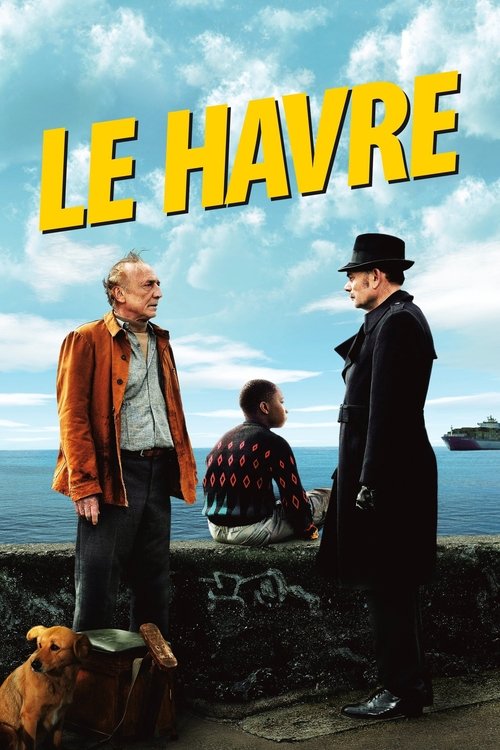
Le Havre (2011)
Genre
:
Drama | Comedy Rating
:
7 / 10
Release Date
:
08 September 2011 Resolution
:
1920x1080
Duration
:
1 : 34 minutes
Spoken Language
:
Français Status
:
Released Overview
:
In the French harbor city of Le Havre, an elderly shoeshiner with an ailing wife crosses paths with a young African refugee pursued by the police for deportation.
Cast Overview :

Marcel Marx
by: André Wilms

Arletty
by: Kati Outinen

Monet
by: Jean-Pierre Darroussin

Idrissa
by: Blondin Miguel

Claire
by: Elina Salo

Yvette
by: Evelyne Didi

Chang
by: Quoc Dung Nguyen
Greengrocer
by: François Monnié
Little Bob
by: Roberto Piazza

Dr. Becker
by: Pierre Étaix

The Whistleblower
by: Jean-Pierre Léaud
Francis
by: Vincent Lebodo

Mahamat
by: Umban U'kset

Detention Centre Manager
by: Patrick Bonnel

The Italian
by: Ilkka Koivula
Mimie
by: Myriam "Mimie" Piazza
Sandwich Vendor
by: Luce Vigo
Greengrocer's Wife
by: Valérie Caron

Border Police
by: Jérôme Boyer
Calais Refugee
by: Jean-Luc Guion-Firmin
Container Park Night Guard
by: Pierre Morineau
CRS Commander
by: Johann Rioux
Trigger-happy CRS Guard
by: Julien Flematti
Medic
by: Éric Duteil
Nurse
by: Corinne Belet
Nurse
by: Dominique Lepagne
Nurse
by: Anne Lizy
Dock Worker
by: Pierre Richards
Dock Worker 2
by: Loïc Jamet
Band Member
by: Nico Garotin
Band Member
by: Bertrand Couloume
Band Member
by: Nicolas Noël
Band Member
by: Gilles Mallet
"La Moderne" Regular / Prefect of Police (voice)
by: Gilles Adam
"La Moderne" Regular
by: Patrick Leboucher
"La Moderne" Regular
by: Michel Lacaille
"La Moderne" Regular
by: Stéphane Livonnen
"La Moderne" Customer
by: Arnaud Clément
"La Moderne" Customer
by: Dominique Comont
"La Moderne" Customer
by: Alain Guillot
"La Moderne" Customer
by: Philippe Hubschwerlin
"La Moderne" Customer
by: Franck Durand
Docker
by: Christian Amyard
Docker
by: Rudy Amyard
Docker
by: Brice Augé
Assassin
by: Lucas Loubaresse
Assassin
by: Ireneusz (Irek) Spiewak
Shoe Shop Manager
by: Gilles Charmant
Housewife
by: Mary Berkelmans
Housewife
by: Seluna Lemercier
Housewife
by: Fanette Martinie
Priest
by: Rémi Pradinas
Priest
by: Stéphane Parthenay
Accordionist
by: Alain Chapelain
Calais Refugee
by: Rachid Bessal
Calais Refugee
by: Oumar Ly
Photographer
by: Emmanuel Ingweiller
Bartender
by: Matthieu Hébert
Fisherman
by: Frank Atinault
Fisherman
by: Dominique Mare
Fisherman
by: Brice Niel
Fisherman
by: Alban Rutten
Fisherman
by: Franck Rutten
Member Reviews :
Simple story, well and gently told in Kaurismäki's characteristic style.
In the 2011 production LE HAVRE, the Finnish auteur Aki Kaurismäki steps away from his usual Helsinki setting for the first in what will be a trilogy of films in Western European port cities. Always rooting for the underdogs, Kaurismäki this time concentrates not just on the disenfranchised urban lower class, but on a socioeconomic strata arguably lower than them: illegal immigrants. Middle-aged shoeshiner Marcel (André Wilms), who lives in a run-down neighbourhood with loving wife Arletty (Kati Outinen) meets Idrissa (Blondin Miguel), a child who has found his way from Gabon to France inside a shipping container. Marcel decides to shelter the boy and see him on to England, his intended destination, but detective Monet (Jean-Pierre Darroussin) is on their heels.
In spite of the French setting, this remains a very Finnish film in its sparse dialogue and deadpan humour. Kaurismäki yet again uses a very drab colour scheme and sets the film ostensibly in the present, but with cars, radios and rock music dating from the 1950s. Like nearly every film he has made, there is a musical performance by an oldies rock 'n' roll band, complete with pompadours and leather jackets. This is getting appallingly repetitive. Basically, if you've seen any two previous Kaurismäki films, then you'll find almost nothing new in the aesthetic and even the plot.
That said, this is a more life-affirming film than his last, the absolutely bleak LÄHIKAUPINGIN VALOT of 2006. Kaurismäki is clearly concerned with the plight of those who would escape sub-Saharan Africa by any means necessary, and this leads the viewer to reflection, but his exposé of detention centres and police harrassment becomes heavy-handed at times.
When a dockworker hears some strange noises emanating from a box recently arrived from Gabon, he's maybe not so surprised to discover that it's cargo is human - and bound for London. Detained by the immigration officials, the young and nimble "Idrissa" (Blondin Miguel) manages to evade his captors and whilst in flight encounters the slightly down-at-heel "Marcel" (André Wilms). The older man takes pity on this nervous new arrival and takes him into his home whilst they decide what's best to do next. It's a small town community and pretty quickly just about everyone at the local pub knows who and where the youngster is, but instead of turning him in, they decide that maybe they can help him. He's no thief, nor malcontent - just a young man bewildered and personable. As "Marcel" begins to learn a little more of his new charge, he determines to try and help him make it to the UK - but with a grudging fifth-columnist amongst their friends and the determined "Insp. Monet" (Jean-Pierre Darroussin) on his trail, things are not going to be a simple case of jumping onto the Eurostar. "Marcel" has other emotional fish to fry, too, as his ailing wife languishes in an hospital facing a prognosis that we, the audience, appreciate but he does not, as yet, know. Choices have to be made and priorities established for everyone as time and circumstances close in. I found there to be a strong and effective dynamic between Wilms and the young Miguel here, and the sparing script allows the characters to breathe and us to observe their respective, and ultimately conjoined, predicaments as the lad struggles without any real roots. At times it has a slightly documentary-style look to it, which adds a little authenticity to the investigative aspects of the drama - a policeman who does his job efficiently, but does he relish it? It packs quite a bit of food for thought into ninety minutes, and does ask us a few questions about our own attitudes - "There but for the grace of God" sort of things. It doesn't attempt to deliver much by way of the relative merits of illegal immigration nor of heinous people trafficking, per se, but again we are presented with a canvas that's drawn by just about everyone - friend and foe - but not much by the young man himself.