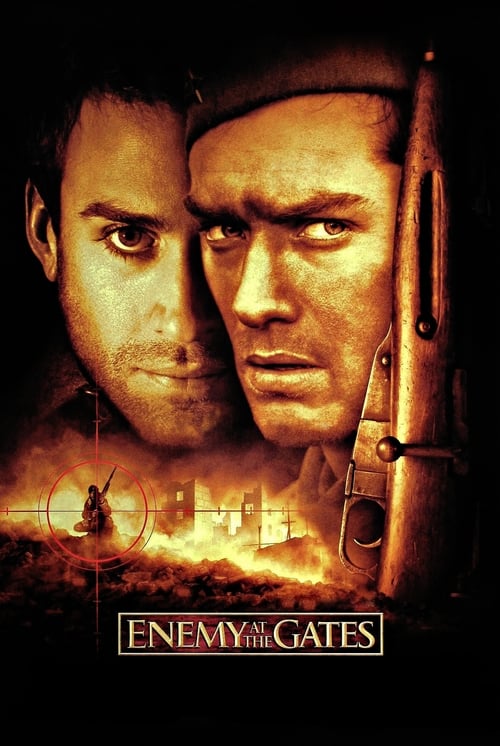
Enemy at the Gates (2001)
Genre
:
Drama | War | History | Romance Rating
:
7.42 / 10
Release Date
:
28 February 2001 Resolution
:
1920x1080
Duration
:
2 : 11 minutes
Spoken Language
:
Deutsch, English, Pусский Status
:
Released Overview
:
A Russian and a German sniper play a game of cat-and-mouse during the Battle of Stalingrad in WWII.
Cast Overview :

Vassili Zaitsev
by: Jude Law

Commisar Danilov
by: Joseph Fiennes

Tania Chernova
by: Rachel Weisz

Major König
by: Ed Harris

Nikita Khrushchev
by: Bob Hoskins

Koulikov
by: Ron Perlman

Mother Filipov
by: Eva Mattes

Sacha Filipov
by: Gabriel Thomson

General Paulus
by: Matthias Habich

Young Vassili Zaitsev
by: Alexander Schwan

Comrade in Train
by: Lenn Kudrjawizki

Russian NCO
by: Gennadi Vengerov

Political Officer
by: Dan van Husen

Volodya
by: Ivan Shvedoff

Ludmilla
by: Sophie Rois
Anton
by: Mario Bandi

Red Army General
by: Hans Martin Stier

German NCO
by: Clemens Schick

Fat Colonel
by: Hendrik Arnst

Aide de Camp
by: Claudius Freyer
Blond Captain
by: Dietmar Nieder

Captain with Lighter
by: Bernd Lambrecht
Stubborn Feldwebel
by: Jim Dowdall

Politruk / Sniper
by: Maxim Kovalevski

Sweating Officer
by: Peter Silbereisen

Stammering Officer
by: Markus Majowski

Spotter
by: Robert Stadlober

Corpse Robber
by: Gotthard Lange

Female Russian Typist
by: Anna Böttcher

Paulus' Aide de Camp
by: Holger Handtke

Stealing Photographer
by: Marc Bischoff

Russian Captain at Headquarters
by: Mark Zak

Russian Lieutenant
by: Thomas Petruo

Comrade in Shelter
by: Dmitri Alexandrov
Pravda Interviewer
by: David Pagel
Izvestiya Interviewer
by: Galina Dobberstein
Krasnaya Zvezda Interviewer
by: Igor Rozinsky
Russian Reporter
by: Sergei Tokarev

Soldier
by: Tom Wlaschiha
Woman Plucking Eyebrows
by: Marischka Schubarth
Woman Officer
by: Natalya Bondar

Athletic Female Sniper
by: Dana Cebulla
Politruk
by: Piotr Papierz
Politruk
by: Jarek Wozniak
Politruk
by: Genia Makarov

Politruk
by: Werner Daehn

Politruk
by: Birol Ünel
Politruk
by: Grigori Kofmann
Politruk
by: Aleksei Nesterov
Politruk
by: Vladimir Vilanov
Junior Politruk
by: Aleksei Volodin
Senior Politruk
by: Gennadi Tselbyansky
Russian Trench Officer
by: André Emanuel Kaminski

Russian Officer
by: Michael Schenk
Russian NCO
by: Jury Cooper
Russian NCO
by: Manfred Witt

Chechen Sniper / Sniper / Russian Officer
by: Arslan Kodirov
Gaunt German Prisoner
by: Axel Neumann
Sniper
by: Morin Smole
Sniper
by: Inna Samain
Female Russian Radio Operator
by: Keta Burowa
Russian Sharpshooter (uncredited)
by: Toby Cockerell
Russian railroad worker / Polish railroad worker (uncredited)
by: Jürgen G.H. Hoppmann
Soldier (uncredited)
by: Kay Hunsicker
Voice on Tannoy (voice) (uncredited)
by: Eddy Joseph
Narrator (voice) (uncredited)
by: Martin Glyn Murray

General Schmidt (uncredited)
by: Valentin Plătăreanu
Russian Guard (uncredited)
by: Thomas Rösicke
Grandfather
by: Mikhail Matveev
Member Reviews :
***War of the rats in crumbling Stalingrad during WWII***
RELEASED IN 2001 and directed by Jean-Jacques Annaud, "Enemy at the Gates" takes place in the last four months of 1942 during the pivotal Battle of Stalingrad. Russian troops are carted in by the literal trainloads as the Germans attack/bomb the city. Once the dust clears the situation settles into a more personal battle of sharpshooting wills. A lowly young Russian soldier named Vassili (Jude Law) distinguishes himself for his shooting skills and is promoted as a national hero to motivate the Russian cause. After numerous German officers are assassinated, Major König (Ed Harris), the top German sniper, is assigned to seek out and eliminate Vassili.
Most WWII films take place on the Western Front whereas "Enemy" is one of only two mainline films I can think of that address the Eastern front, the other being Sam Peckinpah's underrated "Cross of Iron" (1977).
Three things stuck in my mind after seeing “Enemy at the Gates” years ago: (1.) The opening sequence where the Russian troops are boated across the Volga to join the fight is extremely harrowing, not far removed from the opening D-Day invasion in “Saving Private Ryan” (1998), but different. “Enemy” is worth viewing for this sequence alone. (2.) The city-in-rubble sets with bodies strewn everywhere had a lasting impression on me as did the scurrying-like-rats-through-the-rubble warfare. (3.) Some may find this weird, but I always remembered the discreet lovemaking scene while the soldiers lain in the rubble trying to sleep. I'm not sure why this left an impression, maybe because it struck me as so real: Men & women would be drawn to one another and mate even in the worst possible scenarios.
The film was based on the book "War of the Rats" by David L. Robbins and thus intentionally provokes the imagery of human rats scurrying through the debris. The cast also includes Joseph Fiennes as the political officer who elevates Vassili to hero status via his pamphlets and articles, while Rachel Weisz plays the romantic interest between the two. Ron Perlman is also on hand in a limited role as Vassili's sharpshooting comrade.
As with any film based on historical events there are facts-obsessed critics who decry the lack of authenticity in this or that detail (e.g. "The zippers on the trousers aren't right, blasphemy!!"), but "Enemy" gets the gist correct and, besides, it motivates the viewer to research the actual Battle of Stalingrad. What more can you ask for?
The fact is Vassili had 260 verified Nazi kills and played a key role in motivating the Russians to victory in the Battle of Stalingrad, the largest and bloodiest battle in the history of warfare (with roughly 2 million killed, wounded or captured). The movie effectively shows how the Russian combatants weren't necessarily professionally trained soldiers; many of them were peasants, workers, teachers, mailmen, farmers, etc. They knew they could die the next morning hence they celebrated (and made love) while they could. Stalingrad was one of the major turning points of World War II; from then on it was all downhill for Germany.
FINAL WORD: "Enemy at the Gates" details an oft-ignored important aspect of WWII, the Eastern front. It has several memorable scenes, especially the opening crossing of the Volga and also a clever sequence involving a large shard of reflective glass.
THE FILM RUNS 2 hours, 11 minutes and was shot entirely in Germany (Brandenburg and Bavaria).
GRADE: B+