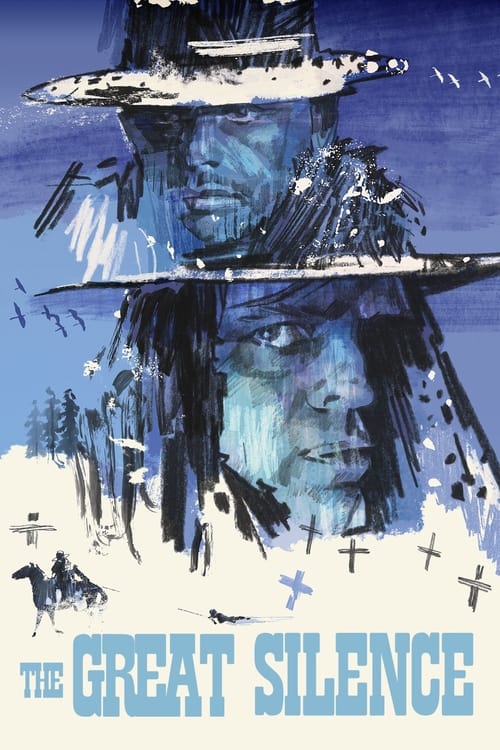
The Great Silence (1968)
Genre
:
Western | Drama Rating
:
7.4 / 10
Release Date
:
22 November 1968 Resolution
:
1920x1080
Duration
:
1 : 46 minutes
Spoken Language
:
English, Italiano, Français Status
:
Released Overview
:
A mute gunslinger fights in the defense of a group of outlaws and a vengeful young widow, against a group of ruthless bounty hunters.
Cast Overview :

Silence
by: Jean-Louis Trintignant

Loco (Tigrero)
by: Klaus Kinski

Sheriff Burnett
by: Frank Wolff

Pollicut
by: Luigi Pistilli

Pauline
by: Vonetta McGee

Martin
by: Mario Brega

Governor
by: Carlo D'Angelo

Regina
by: Marisa Merlini

Blonde Saloon girl
by: Maria Mizar
Black-Haired Saloon Girl
by: Marisa Sally

Sanchez
by: Raf Baldassarre

Walter
by: Spartaco Conversi

Fake Sheriff in Flashback
by: Remo De Angelis

Red-Haired Saloon Girl in Flashback
by: Mirella Pamphili

Outlaw
by: Fortunato Arena

Man in Saloon
by: Giulio Baraghini
Poker player
by: Gino Barbacane

Charlie
by: Bruno Corazzari

Miguel
by: Jacques Dorfmann

Jack
by: Paolo Figlia

Silence's Mother in Flashback
by: Adriana Giuffrè

Outlaw
by: Rocco Lerro

Silence as a boy
by: Loris Loddi
Hunter
by: Mauro Mannatrizio
Hunter
by: William Mayor

Silence's Father in Flashback
by: Emilio Messina

Coachman
by: Benito Pacifico

Governor's Assistant
by: Fulvio Pellegrino

Barman
by: Mimmo Poli

Al's Deputy
by: Aldo Ralli

Hunter
by: Claudio Ruffini

Child
by: Giulia Salvatori

Miguel's Mother
by: Pupita Lea Scuderoni

Governor's Assistant
by: Lorenzo Terzon

Hunter
by: Bruno Ukmar

Hunter
by: Clemente Ukmar

Hunter
by: Franco Ukmar

Hunter
by: Giovanni Ukmar
Poker Player (uncredited)
by: Gianni Di Segni
Member Reviews :
For all I know he is the devil.
The Great Silence is directed by Sergio Corbucci and Corbucci co- writes the screenplay with Mario Amendola, Bruno Corbucci and Vittoriano Petrilli. It stars Jean-Louis Trintignant, Klaus Kinski, Frank Wolff, Luigi Pistilli, Vonetta McGee and Mario Brega. Music is by Ennio Morricone and cinematography by Silvano Ippoliti.
Snowhill, Utah - Winter at the turn of the century, and the local villagers have succumbed to thievery purely to survive. But with that comes bounties on their heads, which brings into the area the bounty hunters who are a law unto themselves. Enter the mute gunfighter known as Silence, who has a deep rooted hatred of bounty hunters...
Something of a cult classic and massively popular in Spaghetti Western fan's circles, The Great Silence is as perpetually cold as the snowy landscapes that surround this tale. Death is a financial commodity, greed and corruption stalks the land, while the shades between right and wrong are as blurry as can be. The violence cuts deep, none more so than with the famous finale that closes down the pic with a pneumatic thud. The photography captures the winter scapes perfectly and is in tune with the narrative drive, while maestro Morricone lays a ethereal musical score over proceedings.
There's some daft goofs such as a dead man blinking and manacles that mysteriously disappear, and not all the acting is of the standard that Kinski and Wolff provide, but this is one utterly unforgettable bowl of Spaghetti. Its reputation in the pasta circles well deserved. 8/10
_**Killers in the snow of the (Italian) Old West**_
In 1898, a mute gunfighter called Silence (Jean-Louis Trintignant) comes to a snowy town in northern Utah where ruthless bounty hunters clash with fugitives in the hills. He accepts a job from a widow (Vonetta McGee) to take out Loco (Klaus Kinski), the man who slew her husband.
Directed & co-written by Sergio Corbucci, “The Great Silence” (1968) ranks with the better Spaghetti Westerns due to several highlights: The awesome snowy setting, a moving score by Ennio Morricone, the silent protagonist, the uniquely beautiful Vonetta McGee (a rare black woman in a prominent role in an old Western), the dastardly villain played by Kinski and the shocking climax. It influenced future Westerns, like “The Claim” (2000) and “The Hateful Eight” (2015).
As with most Italian Westerns from back then, the English dubbing is serviceable at best. The only issue I have on this front is the voice used for Kinski’s character, which seems incongruous.
The movie runs 1 hour, 45 minutes, and was shot about 15 miles from the border of Austria in northeastern Italy (San Cassiano & Cortina d'Ampezzo), as well as the flashback done at Bracciano Lake, Rome, with other stuff done in Elios Studios, Rome.
GRADE: B+
Set against a really effective wintry, hostile, background this tells the story of revenge - and that's always best served cold! A woman "Pauline" (Vonetta McGee) and her family are the victims of unscrupulous bandits. Bent of avenging their heinous behaviour, she hires an equally ruthless and deadly enforcer of her own (Jean-Louis Trintignant) to even the score. This anonymous, mute, gunman is very adept at settling scores, and as the bodies gradually pile up, it looks like a confrontation with the bounty hunter/killer "Tigrero" (Klaus Kinski) cannot be long for the waiting. This is a film that you need to watch with a blanket. The freezing scenarios are used superbly to create a sense of isolation, desperation and the frequent presence of blood spattering the snow helps further illustrate the violent and brutal nature of the lives of the late 19th century Utah citizens - only marginally on the human side of civilisation. The dubbing isn't the best, but the dialogue isn't actually that important. It's the whole look and feel of this film that resonates really well. Kinski and his maniacal eyes, the mute Trintignant (did he just not want to learn any lines?) and the sparing interventions of local kingpin "Pollicut" (Luigi Pistilli) and sheriff "Burnett" (Frank Wolff) all add richness and general unpleasantness to the whole thing. What also helps here is unpredictability. The narrative does not just plod along with the usual hero/anti-hero inevitability to it. The story is alive, it has an authenticity and duplicitousness to it that holds the attention really well before a bleak and, frankly rather savage, denouement that is entirely fitting! It's a great big screen experience!